
Saginaw Street construction halts, but downtown Flint business concerns continue
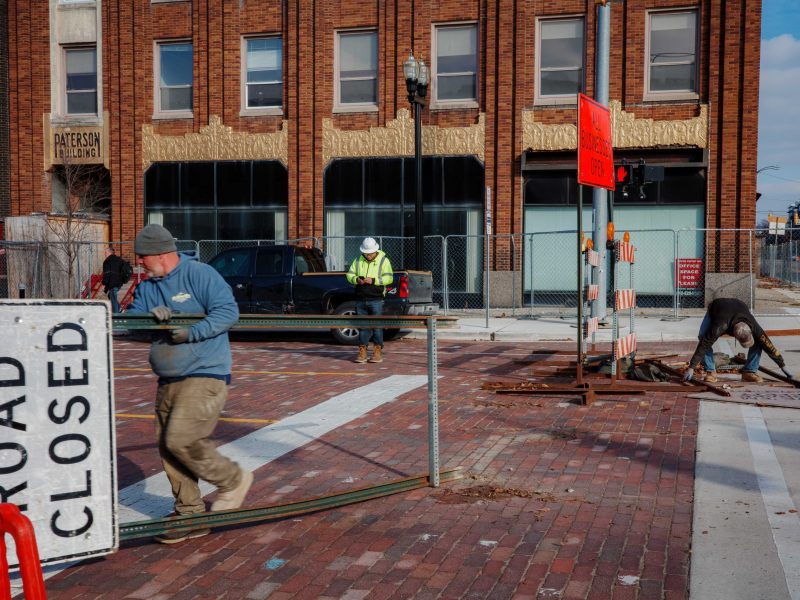
Flint, MI — Construction on downtown Saginaw Street will resume this spring, but multiple business owners along the historic brick roadway say the project’s damage is already done to their 2023 revenue and trust in city administration.
Egypt Otis, owner of Comma Bookstore, told Flint Beat she’d “had enough” when she decided to post about how much the construction project, which broke ground in April and concluded its most recent phase on Dec. 7, has harmed her and other downtown businesses.
“I was pulling up my profit and loss statements, [and] for one month I lost $7,000 and some odd dollars,” Otis said from one of her bookstore’s mustard yellow armchairs on Dec. 5.
She said between that realization, seeing nearly no customers during the store’s normally busy holiday season, and having not heard back from an email she’d sent the city nearly a month ago, she felt compelled to take to social media to talk about her experience.

“I shared a video because I felt like they [the city administration] put me in a position where I didn’t have any other choice. You know? I felt like I didn’t matter,” she said.
On a Facebook Live post, Otis explained that she felt the city’s communication regarding the construction project had been lacking from the start and outlined ways business owners’ situations might be improved through grants, city-funded advertising campaigns, and free downtown parking to encourage guests to visit, despite street closures.
In a separate Instagram post, she wrote that downtown businesses “are suffering,” and that “most organizations don’t seem to care, specifically ones that are positioned to provide small business support.”
Both posts were met with support from commenters, with one downtown employee responding, “Thank you for this. You’ve said what we’ve been thinking,” and another downtown business owner tagging Otis and posting to his own Facebook page that he’d begun having layoff discussions with long time employees.
The Saginaw Street Restoration Project
In 2022, after Flint Beat first reported on the coming brick restoration work on Saginaw Street, city officials said construction would take place block-by-block from East Fifth Street to roughly Riverbank Park.
As funding allowed, initial plans to replace the segment’s intersections with stamped concrete and reuse original bricks were expanded.
The project now includes the replacement of 90% of the segment’s sidewalks, accessibility upgrades, and the replacement of a 100-year-old water main beneath the roadway. The water main replacement also includes replacing the service lines connected to it, which City of Flint Communications Director Caitie O’Neill said will update lines for roughly 30 downtown businesses “regardless of composition.”
Crews broke ground on the project on April 10, 2023, with city officials and Wade Trim, the contracted project manager, estimating the phased work (including planned pauses for summer events and a few months of winter downtime) would conclude in roughly two years.
That timeline was later shortened to Fall 2024 as initial segments of the roadway were completed.
But while the project’s scope expanded and timeline shifted, the communication around it didn’t according to Dan Spaniola, owner of Paul’s Pipe Shop.
Spaniola has worked in his late father’s shop since he was 12 years old, with over 40 of the intervening years spent at the shop’s current Saginaw Street location.
He said the Flint community holds a special place in his heart after decades in the city, but he’s now having to consider whether or not to move — and if he can even afford to do so.
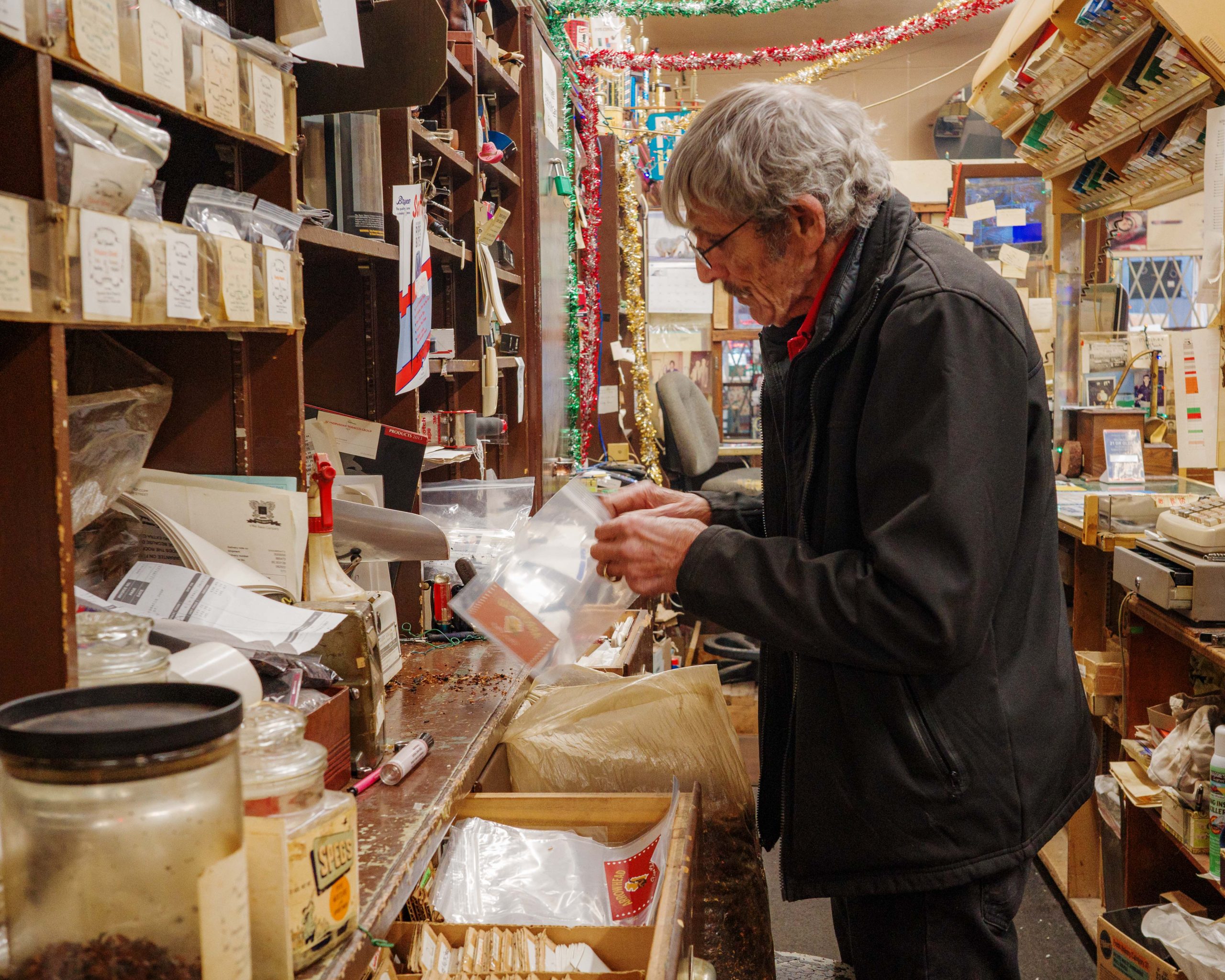
Spaniola told Flint Beat that the shop never returned to its pre-COVID-19 numbers before the construction started this year, but losing the parking spaces out front while the project progressed has not helped his bottom line.
“Most of my customers are older clientele,” the 77-year-old said from behind the shop’s counter on Dec. 5. “They cannot walk the two extra blocks to get here.”
Adding to that accessibility concern, a condemned building next door to Paul’s Pipe Shop collapsed into Brush Alley in July. The collapse prompted the city to shut down immediate access to the alley, and thereby, its few dedicated spaces for the shop.
“Now you can’t even get in the alley, so that’s where it’s been since then,” Spaniola expressed, while brushing at the counter with his tobacco-stained fingertips.
Another blow came when an error in materials used for the first completed sections of the construction project saw the shop’s block of Saginaw closed again in late September.
After that, the segment of roadway was in various states of closure until crews removed barriers on Dec. 7, he explained, while they re-did the work.
Spaniola said he’s been in contact with the city periodically through all of these issues, like when officials began seeking demolition funding for the collapsed building next door. (That funding was approved by Flint City Council on Nov. 29.)
But while there seems to be some urgency to solutions now, Spaniola told Flint Beat he’s not sure if the administration truly understands how detrimental the project has proven to be for him and other downtown business owners.
In further explanation, he referred to a loan program for businesses affected by the downtown construction, which he believed the city connected him to through Metro Community Development.
He recalled the loan terms as being $10,000 at 0% interest for three years.
“That won’t even cover one month,” he said. “I just laughed… I can’t make money, how do you expect me to pay to be able to do that?”
While Spaniola said he passed, other business owners did take advantage of the program according to Tiffany Bernethy, a commercial loan officer with Metro.
Bernathy said that due to privacy concerns, she could not disclose which businesses had participated in the program, which offered both the terms Spaniola noted or a $10k to $15k loan at 3% interest over five years.
However, she could confirm in a Dec. 7 email “that approximately a dozen businesses took advantage of the program for a total of about $150,000.”
Back at Comma, Otis told Flint Beat she was one of those businesses who had accepted Metro’s support, but she echoed Spaniola in saying such funding isn’t helpful when you aren’t making money.
“I was hoping that by the time I received the loan that business would pick up and the project would be done,” Otis stated. “Now, I’m in even more of a bind because I’m essentially just paying back a loan that I wasn’t able to make a profit from… As I stated, businesses need emergency grant funding and parking incentives.”
Small Business Resources and City Communication
When Flint Beat reached out to the city about the solutions downtown business owners asked for, O’Neill said that while the city has been connecting businesses with resources, it “cannot offer direct grants.”
She referred to the loan program Spaniola and Otis mentioned, which was offered in late October, as well as the city’s Community Navigator Pilot Program, which ran from November 2021 through November 2023.
“This program resulted in businesses across the city accessing over $1,080,000 in capital,” O’Neill wrote in a Dec. 6 email. “Over 250 small businesses and entrepreneurs citywide received technical assistance tailored to their needs, including business planning, marketing, growth strategies, projections, inventory systems, technology, POS systems, branding, and more.”
Lee Grant Allen is the co-founder of BAU-HŌUSE, which is a creative space and apparel shop in downtown’s Buckham Alley. He said he understood the city might not normally be able to issue grants.

“But they have ARPA funds,” he said, referring to Flint’s American Rescue Plan Act (ARPA) funding, which has not yet been fully allocated. “Stuff is being funded in the city.”
He said he’d like to see the city work with business owners on more direct support services and funding, as owners aren’t just advocating for themselves, but also their staff and vendors’ livelihoods.
“These are people who rely on their clothes and merchandise moving for profit, right?” he said of his business model, which relies on cycling through multiple vendors as their products sell out. “When I can’t take on vendors, to me, that’s it. That’s an issue.”
Allen added that he agrees with Otis’ concerns and proposed solutions. He said his October sales dropped roughly 30% since last year, and road closures — both with the Saginaw Street project and intermittent Consumers Energy work — have at times blocked the entrance to the one-way alley his storefront faces.
O’Neill did not mention ARPA funding in her email, but she did cite other small business resource providers the city refers to, including the Small Business Development Center at Kettering University, the Flint & Genesee Economic Alliance, and the University of Michigan-Flint’s Office of Economic Development.
“While the City of Flint can connect small businesses with resources, we cannot control how individual entrepreneurs respond or engage with those resources,” she wrote.
In response to business owners’ claims of poor communication, she said the city has been in contact with downtown’s small businesses throughout the construction process.
O’Neill cited the website, FixTheBricksFlint.com, which is maintained by Wade Trim and contains lane closure information and periodic updates on the downtown construction work.
“As the project managers, they are best equipped to provide specific updates on project developments,” she wrote.
She also noted that the city’s small business specialist attends Flint’s Downtown Small Business Association (DSBA) meetings and has been “routinely checking in with downtown small businesses, fielding concerns, and connecting business owners with information and resources” alongside the city’s “press engagement and web-based communications.”
The Flint DSBA did not respond to Flint Beat’s request for comment by press time.
Regardless of whether downtown business owners agree on the effectiveness of the project communications, O’Neill told Flint Beat those owners are being heard.
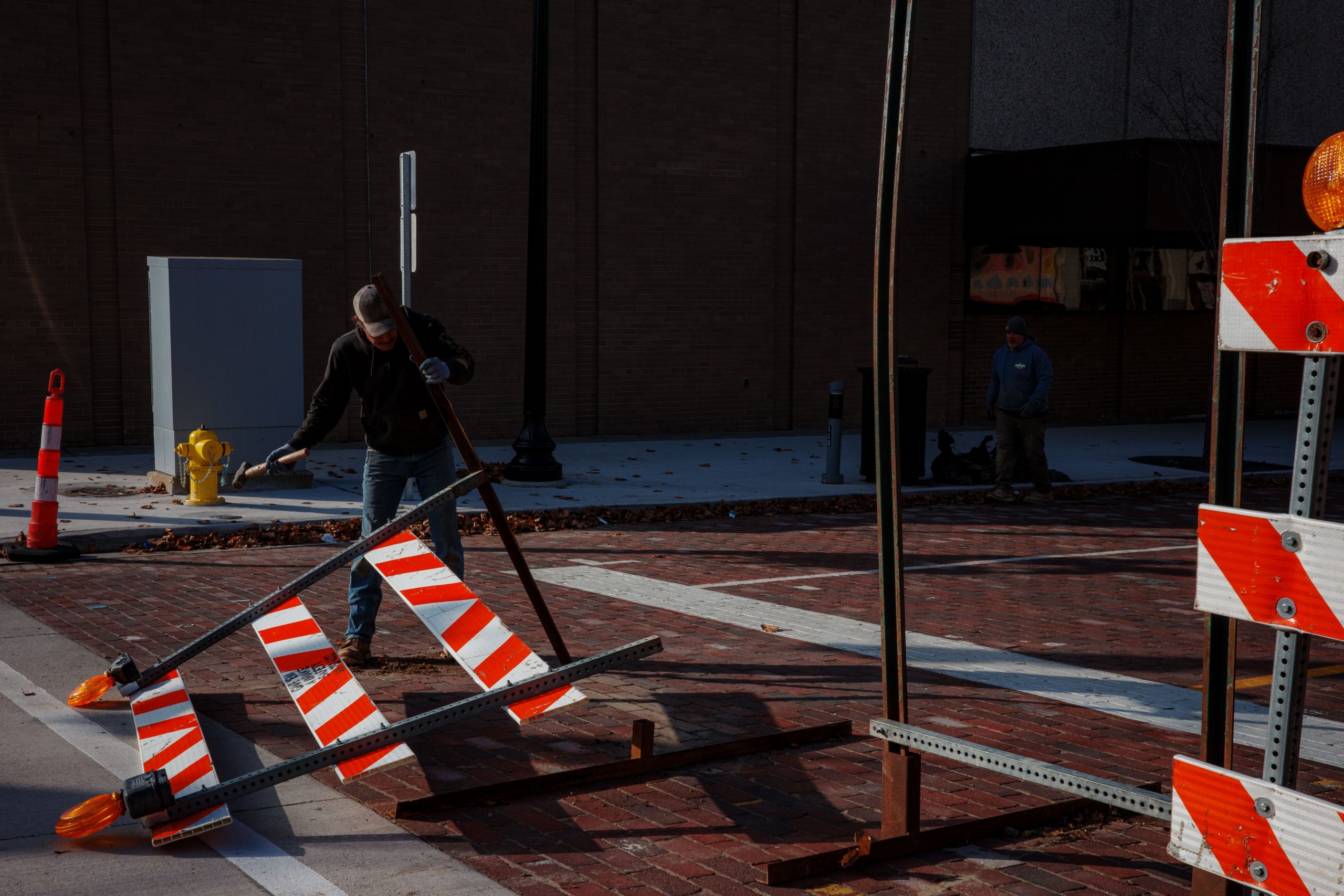
While the most recent project phase was projected to conclude by Dec. 15, crews instead finished early and pulled up Saginaw project’s barriers the afternoon of Dec. 7.
Additionally, when the city moves forward with the final part of the project in April 2024, it will be disregarding the prior phased approach in favor of closing Second Street to the Flint River all at once.
“This will improve workflow and get the job done faster,” O’Neill wrote, adding that the single, sweeping street closure means construction is now projected to finish in July 2024 instead of fall 2024. “This faster project timeline should be less disruptive to downtown businesses.”
In response to the removal of barriers, early pause in construction, and the promise of a faster timeline, Otis told Flint Beat she viewed the actions as “a response to the collective voices” of Flint’s business owners and residents who “made clear that they do care about the downtown community.”
She said this was a welcome start, and she hopes to see the city include more diverse voices in development conversations moving forward, as well as hold itself accountable to the promises now made regarding the Saginaw Street project’s timeline and communications.
“This is progress,” Otis concluded. “It’s progress.”
Support local news!
Flint Beat is here to empower, impact and inform our community. Show your support today!
Choose a monthly amount
Basic
Standard
Pro
Custom Amount
Thank you for your support!
Author